Guide
How to sell on Bring a Trailer: the documentation & photo playbook
Bring a Trailer is not a classifieds site — it is a curated auction house with a comment section. Cars are selected, listings are edited by BaT’s own team, and bidders interrogate every claim in public. The sellers who do well there share one trait that has nothing to do with the car: their documentation was finished before they applied. This playbook is that preparation, step by step.
Published October 2026 · Fees and process details are cited to their sources below and change over time — confirm current figures on BaT’s seller pages before you submit.
Step 0: Understand what BaT actually is
BaT ran 49,486 listings and $1.7 billion in sales in 2025, with an 81% sell-through rate — numbers that exist because the platform says no. Every submission is reviewed by BaT’s auction team, and acceptance is earned, not purchased. BaT’s own leadership describes the selection as part data, part curatorship: vehicles are chosen on condition, quality of information, quality of photos, the reserve you request, and what similar cars are already doing on the platform. Howard Swig, BaT’s head of auctions, puts the documentation point bluntly: you could have a wonderful car, but with five photos and a one-liner description, it will not make a successful auction.
Read that again, because it reorganizes the whole job: the submission is a pitch, and the record file is the pitch deck. Everything in this guide follows from that.
Step 1: Pass selection — the file is your application
BaT receives hundreds of submissions a week, and the review team evaluates each against the same questions a bidder will later ask: What is it, exactly? Who has owned it? What’s been done to it, and what proves it? Is the reserve realistic against recent comparable results? Preparation services that submit cars professionally report the same rejection patterns again and again:
- Incomplete service history or vague ownership records — the file can’t answer who owned it or what’s been done
- Poor-quality or incomplete photos — the submission set doesn’t show the car a reviewer needs to see
- Descriptions that lack transparency — known issues unmentioned, claims unbacked
- Reserve expectations the comps don’t support — BaT knows its own results better than you do
- Weak-market variants presented as strong ones — a curatorial no, softened only by an honest file and a realistic reserve
For a first submission, BaT recommends uploading 10–20 photos that tell an accurate story of the car — treat that as the floor for the application, not the listing. The practical sequence: assemble the record file first (the full system is our collector car documentation checklist), build your comps sheet from BaT’s own past results, set a reserve the evidence supports — then submit. Sellers who start from a finished file also start from an advantage nobody mentions: if BaT passes, the same file is your Cars & Bids submission, your consignment packet, and your private-sale handout. Nothing is wasted.
Step 2: Build the documentation packet
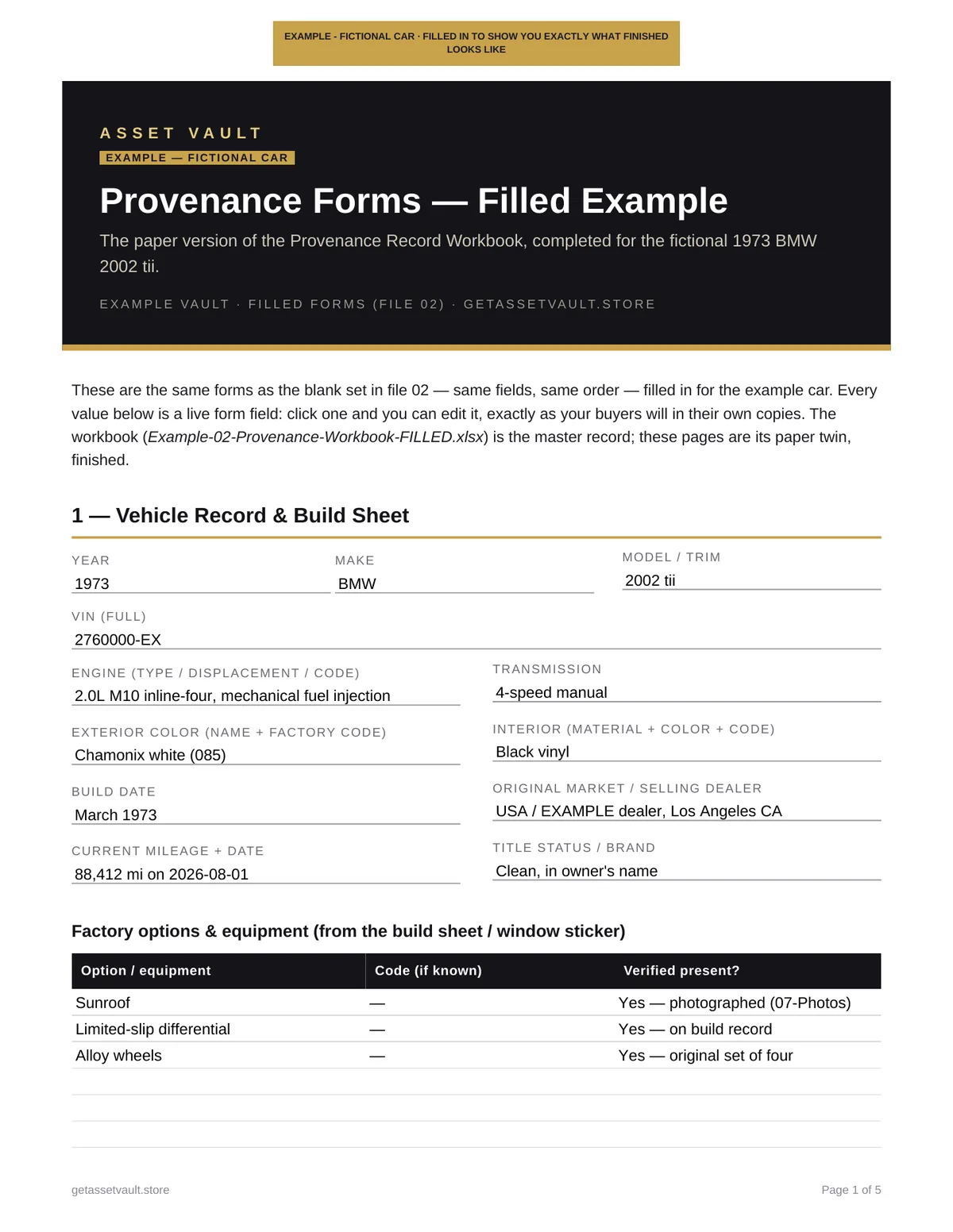
Whether your car is accepted this month or next season, the listing will be built from a packet — the documents BaT’s team requests and the comment section will demand. Assemble it in gallery order, scanned and legible:
- Title and identity: clear title in the seller’s name, VIN plate and data-plate photos, VIN decode, build sheet or heritage certificate where the marque offers one
- Ownership chain: prior owners, years held, mileages — gaps labeled as gaps
- Service and repair records: the chronological log plus the invoices behind the major entries — engine, gearbox, suspension, brakes, paint
- Receipts for significant parts: supplier, part numbers, cost — the provenance of what’s on the car now
- Condition evidence: inspection results, compression/leakdown where relevant, paint-meter readings, and your written known-flaws list
- Video: a genuine cold start, idle, and a driving clip — BaT’s audience treats these as baseline, not bonus
The packet does double duty. BaT’s specialists use it to write and verify your listing; then, once live, it becomes your ammunition in the comments — every document already scanned is an answer you can post in minutes instead of a promise to “check and get back to you.”
Step 3: Meet the photo standard — 100 to 200, on purpose
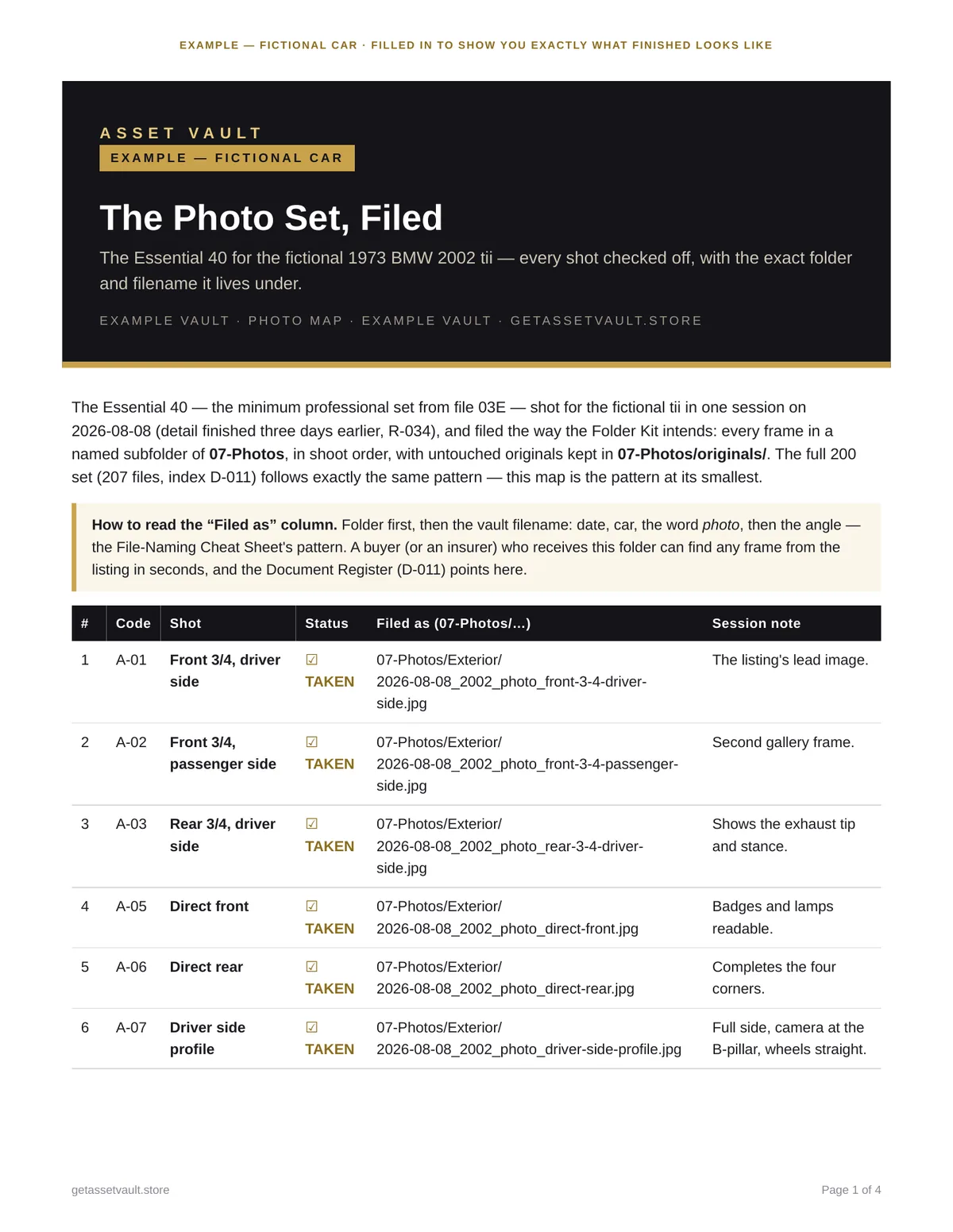
The working standard for a successful BaT listing, as stated by the preparation services that shoot for the platform, is 100 to 200 photographs: every angle of the exterior, the interior, the underbody, the engine bay, trim and imperfections, VIN tags and service stamps. This is not gallery padding. BaT’s buyers bid serious money on cars most will never stand next to; the photo set is their inspection, and missing shots — no underbody, no plates, no flaws — read as concealment whether you meant it or not.
Work the set as a checklist, in this order:
- Exterior, complete: every angle and panel, close-ups of gaps, glass, lights, badges, wheels and tire date codes
- Underbody: on a lift wherever possible — floors, rails, suspension, exhaust, any corrosion, shot honestly
- Engine bay: overall plus stampings, data plates and ancillaries; leaks shown, not wiped and hidden
- Interior and trunk: seats, dash, working gauges, headliner, carpets, spare and tools
- Documents as photos: title, build sheet, key invoices — bidders read the gallery, so the records belong in it
- The flaws gallery: every chip, tear and seep, close up. Disclosed flaws build the trust that bids are made of
Our pack’s 200-shot list (Premium tier and up) is this standard written out shot by shot; the general method — including how to sequence photo day against your listing date — is in the auction listing preparation guide. Technique matters less than coverage and honesty: consistent natural light, a clean backdrop, the same angles a buyer would walk. Heavy filters and glamour angles backfire on a platform where the audience zooms in.
Step 4: Write the listing from the file
BaT assigns a specialist who drafts the listing text with you — the Classic listing includes a dedicated point of contact who writes the description. That does not make your draft optional. The team works from what you submit: a solid, organized set of specs and records produces a listing that sounds like your car; a one-liner produces a generic one, and the comment section can tell the difference. BaT’s editors reshape and trim — a transparent, well-sequenced draft survives that process with its credibility intact.
Write from the file, in evidence order: identity and matching-numbers status where relevant; the ownership story; the major work with dates, shops and invoice references; modifications, stated plainly with reversibility; the flaws, in the text, before a commenter finds them. Skip the poetry. On BaT, the sentence that sells is the one that ends “— invoice in the gallery.”
Step 5: Auction week — answer with evidence
Once live, the auction is a public examination that runs for days, and the prepared seller’s advantage compounds. Bidders and commenters will test the car technically: last belt service? Compression numbers? A photo of the undercarriage stamp? Paint-meter readings? Three things decide how that goes:
- Speed. A document posted within the hour keeps momentum; silence reads as evasion, and bidders move on.
- Accuracy. Answer from the file, not from memory — a wrong recollection corrected later costs more trust than a slow right answer. If you don’t know, say so and go find out.
- Tone. Factual and unhurried, especially on flaws. The room is deciding whether to trust you with a wire transfer; every reply is evidence.
Two mechanics to know before you’re in it: once an auction is live it cannot be cancelled and the car cannot simply be relisted if it misses — but you can lower the reserve during the auction if bidding stalls below it. Decide your walk-away number from the comps sheet before the final day, not during it.
The same file works on Cars & Bids
Cars & Bids runs the same essential play with a younger, more modern-car mix: curated submissions, an emphasis on photos and honest presentation, and a comment culture that rewards sellers who document. Nothing in this playbook is BaT-exclusive — the packet, the photo standard scaled to the venue, the comps-based reserve, answering with evidence. Build the file once and it serves both platforms, plus every consignment conversation and private buyer who follows. Platform-specific fees and formats differ and change; the documentation doesn’t.
Fees and timeline: the reality check
| Item | What to expect |
|---|---|
| Seller listing fee | $99 for BaT’s Classic listing, which includes the specialist who drafts your listing with you. A Plus tier ($349) adds professional photography shot to a comprehensive checklist; white-glove handling exists for significant cars and collections. (Reported by The Drive from BaT’s team; confirm current pricing on BaT’s seller pages.) |
| Buyer’s fee | 5% of the winning bid, with a $250 minimum and a maximum cap — the cap figure has been revised since it was reported at $5,000 in 2021, so check BaT’s current schedule. It’s the buyer’s cost, but it shapes bidding headroom on your car. |
| If it doesn’t sell | No sale, no percentage — but the listing fee is spent, the car has been publicly unsold at that reserve, and BaT does not offer simple relisting. This is why the comps-based reserve in Step 1 matters more than optimism. |
| Submission to listing | Not instant: curated review, listing build with your specialist, then scheduling. Sellers who arrive with the packet finished skip the slowest part — the back-and-forth for documents and photos. |
| The auction itself | About a week live, with the comment thread running throughout — plan to be present and responsive for all of it, especially the final hours. |
| Preparation services | Flat-fee concierge services will run the whole submission for you — a legitimate cost for a six-figure car, and a useful benchmark: everything they do starts from the same documentation this guide builds. |
The honest summary: BaT’s own fees are the smallest cost of selling there. The real cost is preparation — 10–20+ hours of it if you start from a shoebox, or an afternoon of assembly if the file already exists. That difference is the entire business case for keeping the record while you own the car.
The Premium tier is the BaT tier
The Sale-Ready Vault Pack’s Premium tier ($149) was built for exactly this listing: the full 200-photo auction shot list, the auction listing preparation checklist, the valuation & comps worksheet, and the sale-ready export builder that assembles the packet in Step 2. Essentials ($99) keeps the record file; Premium prepares the sale.
Frequently asked questions
Does BaT accept every car submitted?
No — it is a curated platform, and rejections are common enough that preparation services exist largely to avoid them. Condition, information quality, photo quality, your requested reserve and platform fit all factor in. A complete record file and a comps-based reserve address the factors within your control.
How many photos do I honestly need?
For the application, 10–20 that tell the car’s story accurately. For the live listing, work to the 100–200 standard the platform’s preparation ecosystem uses — full exterior, underbody, engine bay, interior, documents and flaws. Fewer can sell a car; the standard exists because galleries at that depth are what the strongest results are built on.
My records are incomplete. Should I wait to submit?
Submit with what you can prove, labeled honestly — a partial file presented straight beats a padded one, and BaT’s audience punishes invention far harder than gaps. But build the file first if you can: every week of preparation before submission is worth more than the same week spent apologizing in the comments.
Sources: The Drive, “Tips and Trends to Know When Selling on Bring a Trailer” (BaT leadership on selection, submission photos, listing fees and buyer’s fee, thedrive.com). Reserve Lane, “What It Really Takes to Sell a Car on Bring a Trailer” (submission evaluation, rejection patterns, the 100–200 photo standard, comment-section dynamics, reservelane.com). Bring a Trailer 2025 results, company announcement. Photo and prep-time estimates also in our auction listing preparation guide.
Related guides
- Auction listing preparation — the platform-general version: photo set, records packet, and the T-minus timeline for any online auction.
- The collector car documentation checklist — the complete record file the BaT packet is assembled from, item by item.
- How to sell a collector car for more — the documentation playbook: turning records into price, on any venue.