How It Works
Built while you own the car. Cashed in when you sell it.
The Asset Vault workflow has three movements: document the car as you go, organize the file against a proven standard, then export a sale-ready packet in one pass — for auctions, private sales, or your insurer.
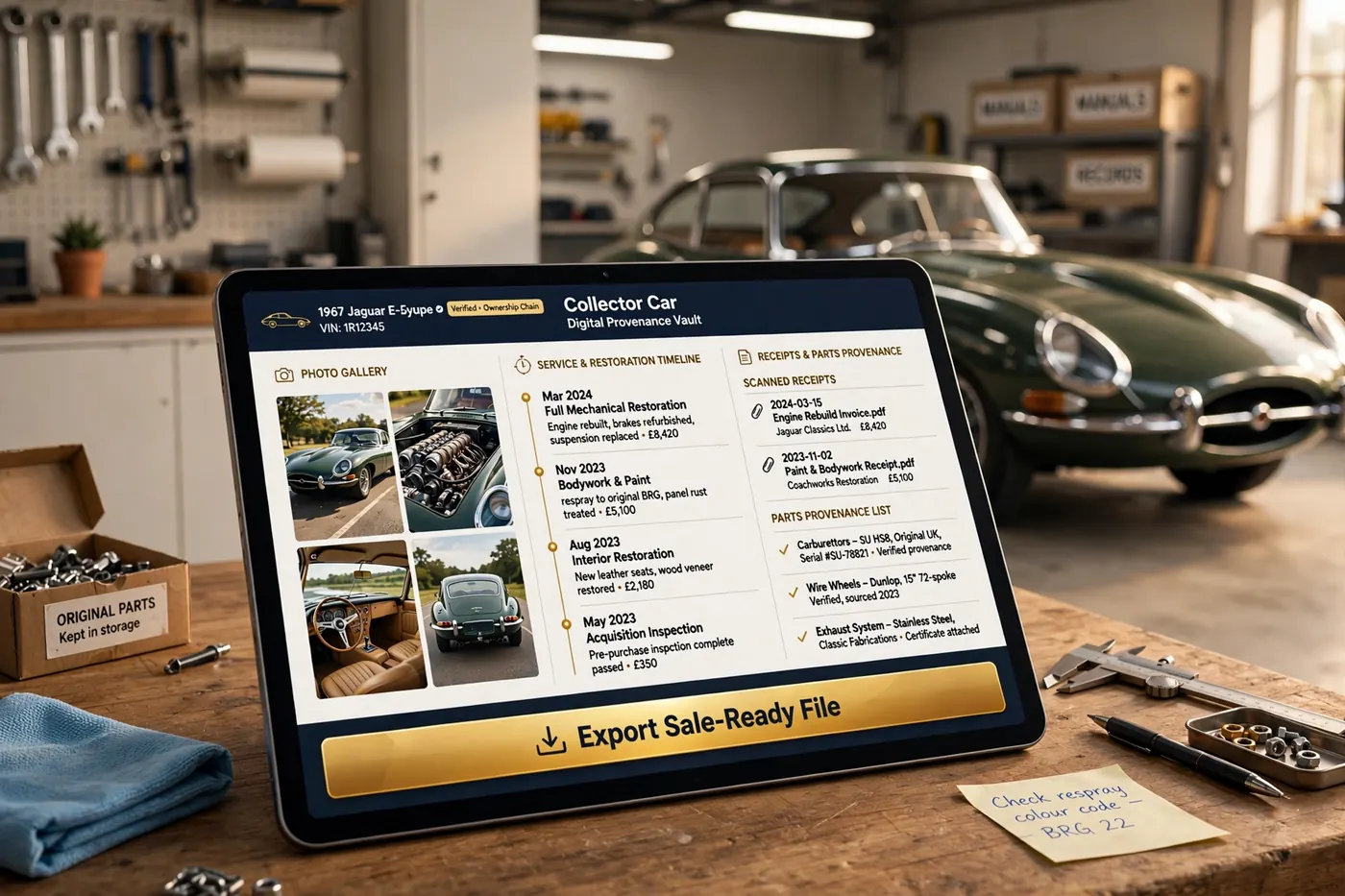
Step 1 — Document
Every job gets a ten-minute entry while it’s fresh: date, mileage, who did the work, what parts went in, what it cost, and the photos you already took. The pack’s logs are built for the work history reports never see — your own wrench time, your independent shop, the parts you sourced yourself.
- Build sheet & vehicle record master file
- Service, repair & DIY history log
- Receipts & parts provenance log (supplier, part numbers, cost)
- Ownership history worksheet — the chain of custody buyers ask about
Step 2 — Organize
A pile of receipts is not a record. The organization step puts the file in the order evaluators think in — identity, history, condition, proof — and finds the gaps while there’s still time to fill them.
- Provenance Score self-audit — score the file 0–100 across eight categories: identity & build data, ownership chain, service records, receipts, parts provenance, photo documentation, valuation evidence, and sale materials
- The photo shot lists — 40 essential shots in Essentials; the full 200-shot auction list in Premium and Concours
- Document index — every document named, dated and findable in seconds
Step 3 — Export
When the car sells — or when your insurer asks what it’s worth and why — the export builder assembles the packet in one pass instead of one panicked weekend.
- Auction packet — record summary, photo set, receipts digest and listing description worksheet, formatted for Bring a Trailer / Cars & Bids style listings
- Insurance packet — documentation bundle for agreed-value discussions with your insurer
- Private-sale packet — the same file, formatted for a single buyer’s due diligence
The packets organize your records. They are not a history report, an appraisal, or a valuation — insurers and buyers make their own determinations; your file makes their job easy.
The Provenance Score
A number for the file, not the car
The Provenance Score (Concours tier) is a self-audit rubric, not an appraisal. It scores how completely a car is documented — because completeness is what you control. A car with a 40-point file and honest gaps will usually outsell the same car with a shoebox and a shrug, because the buyer can see exactly what they’re getting. The audit shows you which categories to strengthen next, in priority order.
Find the gaps
Missing build data? No receipts before 2019? The audit names the holes before a buyer’s questions do.
Fill them cheaply
Most gaps close with an afternoon: a photo session, a call to the shop that did the work, a scan of the folder in the filing cabinet.
Sell the strength
A high-scoring file becomes listing copy: “documented engine-out service, receipts on file, 214 listing photos.” Proof beats adjectives.